One research study. Eight markets. Real user insights.
- Stakeholders
- UX Research · Product · Regional Market Teams · Content Design
- My role
- Research planning · Test design · Localization · Coordination · Asset creation · Maze setup · Data synthesis · Strategy
- Duration
- 2 weeks
- Tools
- Google Docs · Figma · Slack · Maze · Google Slides
Context
Arabic content at talabat serves users across multiple markets, each with its own linguistic preferences and conventions.
We wanted to better understand how users actually preferred to experience Arabic across the product — and whether localized dialect consistently created a more natural experience than Modern Standard Arabic (MSA).
Our starting hypothesis was simple:
“Users would prefer localized Arabic dialect across app touchpoints.”
To test it, we conducted a regional preference study across eight markets: the UAE, Kuwait, Qatar, Bahrain, Oman, Egypt, Jordan and Iraq.
The challenge
Arabic localization isn’t a binary choice between Modern Standard Arabic and dialect.
Language that feels engaging in a promotional message may not create the same sense of clarity or reassurance in a transactional one. Preferences can also vary significantly from one market to another.
Rather than relying on assumptions about what “localized Arabic” should sound like, we wanted to understand when localization adds value, where MSA works better, and how those preferences change across markets and touchpoints.
My role
I owned the project end-to-end in collaboration with our UX Research and regional market teams.
I worked with the Research team to shape the study and map out the questions, coordinated with market teams to source and validate localized copy, created the test assets in Figma, built and launched each market’s test in Maze, collected and synthesized the results, and translated the findings into a localization strategy that I presented back to our market POCs.
Research design
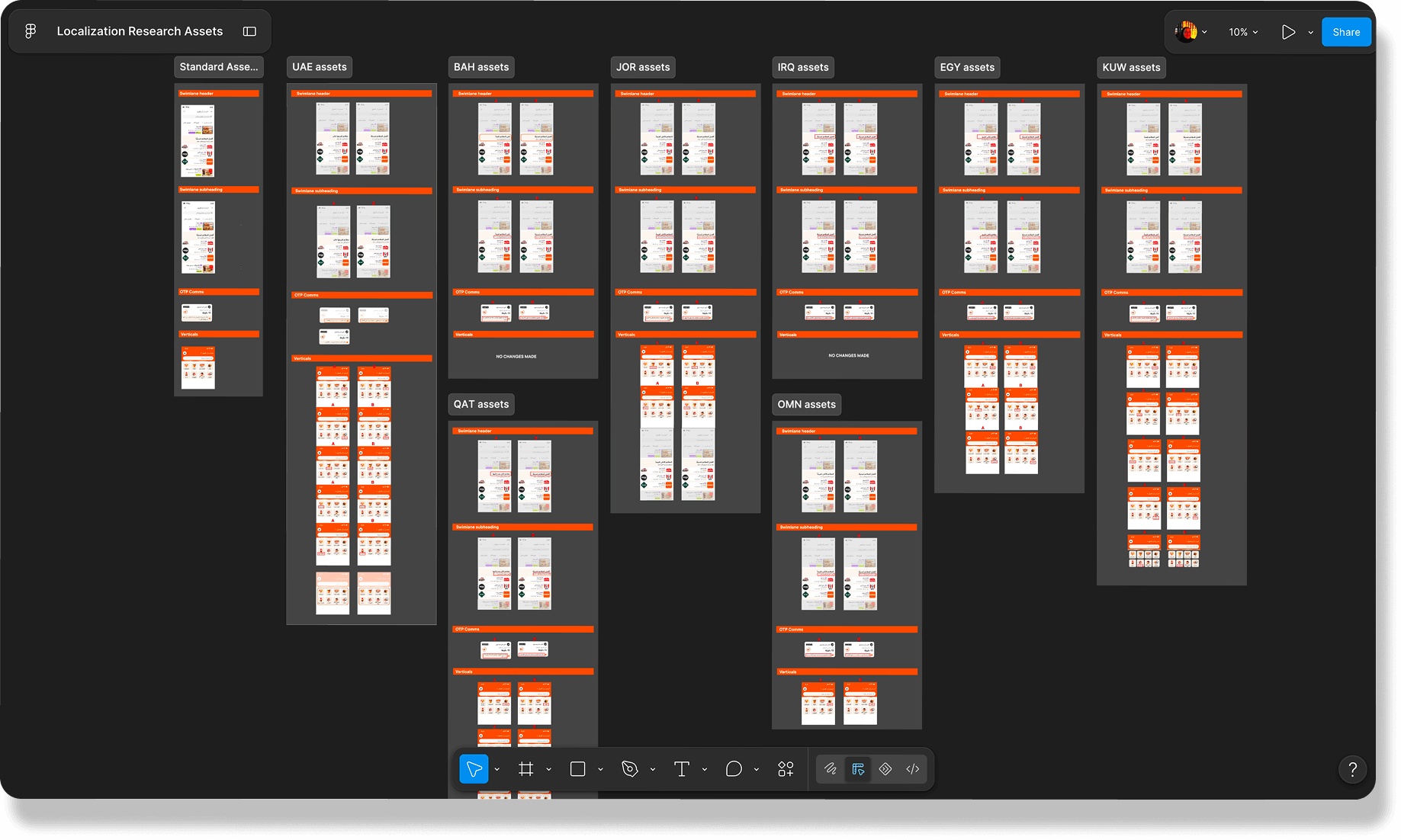
We ran an unmoderated preference study with active Arabic-language talabat users across eight markets, gathering approximately 100 responses per market.
Participants compared Modern Standard Arabic with localized Arabic across three common product touchpoints:
- Swimlanes
- Post-order messaging
- Vertical tiles
By keeping the UI consistent and changing the language approach, we could explore how preferences shifted depending on both the market and the type of message.
The hypothesis didn’t tell the whole story
The results varied significantly across markets and touchpoints.
Localized Arabic performed well in several discovery and food-related experiences, while MSA was often preferred in post-order messaging and other moments where clarity and reassurance played a greater role. Individual markets also behaved differently, reinforcing that there wasn’t one language approach that could simply be applied across the region.
The research also highlighted an important distinction:
“Users weren’t necessarily asking for more dialect — they were responding to language that felt more conversational and natural.”
“What level of localization is right for this market, message and moment?”
From research to strategy
The findings helped us move away from treating Arabic localization as a binary decision.
Instead, I developed a framework that considered language on a spectrum:
The appropriate approach could then be determined by the purpose and context of the content rather than applying one writing style everywhere.
MSA for reliability
Particularly where clarity, reassurance and functional communication matter.
Localization for relatability
Introducing familiar language where a more locally relevant experience adds value.
Conversational for real
Prioritizing simple, natural Arabic over dialect or slang for its own sake.
Outcome
The research gave us evidence to move beyond assumptions about how Arabic should be localized across the product.
Rather than defining one regional rule for MSA or dialect, the resulting strategy provided a more flexible way to make localization decisions based on market, context and user need.
The findings were synthesized into actionable recommendations and shared with regional market POCs, creating a foundation for a more intentional approach to Arabic localization across talabat.